Amani Newton

Courses you can't click your way through.

I'm Amani Newton. For eight years I've made technical products learnable, for Google's developer teams, Meta Blueprint, and now Filigran Academy. I build scenario-based courses where learners make decisions, get some of them wrong, and leave able to do the work.

A sample question, written the way I write them

A learner scores 100% on the quiz at the end of a lesson. What does that tell you?

Select one. You'll get feedback for every choice.

Work

OpenCTI 101: Foundations

A foundations course for Filigran's threat intelligence platform, rebuilt from book-length reading material into scenario-based elearning. Published November 2026.

The source was eight lessons of core reading with a midterm. It was thorough, and it asked learners to read. My job was to turn it into a course a new user would finish and could use.

I wrote the goal first: given a realistic situation, a learner can tell the platform's core concepts apart and choose the capability that fits. This is a course about what you need to understand before you start using the product, taught inside the product.

My role
Instructional design, writing, visual direction, and build
Audience
Cybersecurity professionals who are new to OpenCTI
Format
Six self-paced modules, a gated knowledge check, and a capstone simulation
Tools
Articulate Rise 360, Storyline 360, Review 360, SCORM 2004

Play the course

All six modules, the knowledge check, and the capstone open right here, with no account and no sign-up. Progress isn't tracked or saved.

Start with Module 1

  1. Why OpenCTI Exists
  2. The OpenCTI Data Model
  3. Seeing How It ConnectsThen take The Handover Review, the 14-question knowledge check.
  4. Getting Data Into OpenCTI
  5. Finding What You Need
  6. Getting Intelligence Out
  7. Capstone: The Thursday BriefA case to investigate, with a recommendation to make at the end.

The thumbnails sketch the idea that runs through the course. Module 1 opens on six pieces of information with nothing between them. Each module adds connections. Arrowheads appear from Module 3, the module about relationships.

Decisions that shaped it

Start where customers get stuck
Before designing anything, I built an AI agent to read more than 500 support tickets. The recurring problem was gaps in concepts, and that shaped the redesign.
Structure before sentences
The objective, module sequence, activity types, and assessment strategy were settled before I wrote any learner-facing copy.
Teach the distinctions
Product knowledge is taught as skills: telling similar things apart, applying a concept, following a rule, knowing the exception. Module 2 is built around entity types that look alike, such as a threat actor and an intrusion set.
One scenario, start to finish
Every module takes place at the same fictional regional bank, in the learner's first days on its threat intelligence team. Each one closes with a Thursday threat review that sets up the capstone.
A fixed kit of seven activities
Seven activity types, reused throughout. No new type appears after Module 3, so learners spend their attention on the content and not on a new mechanic.
Custom builds only where they teach
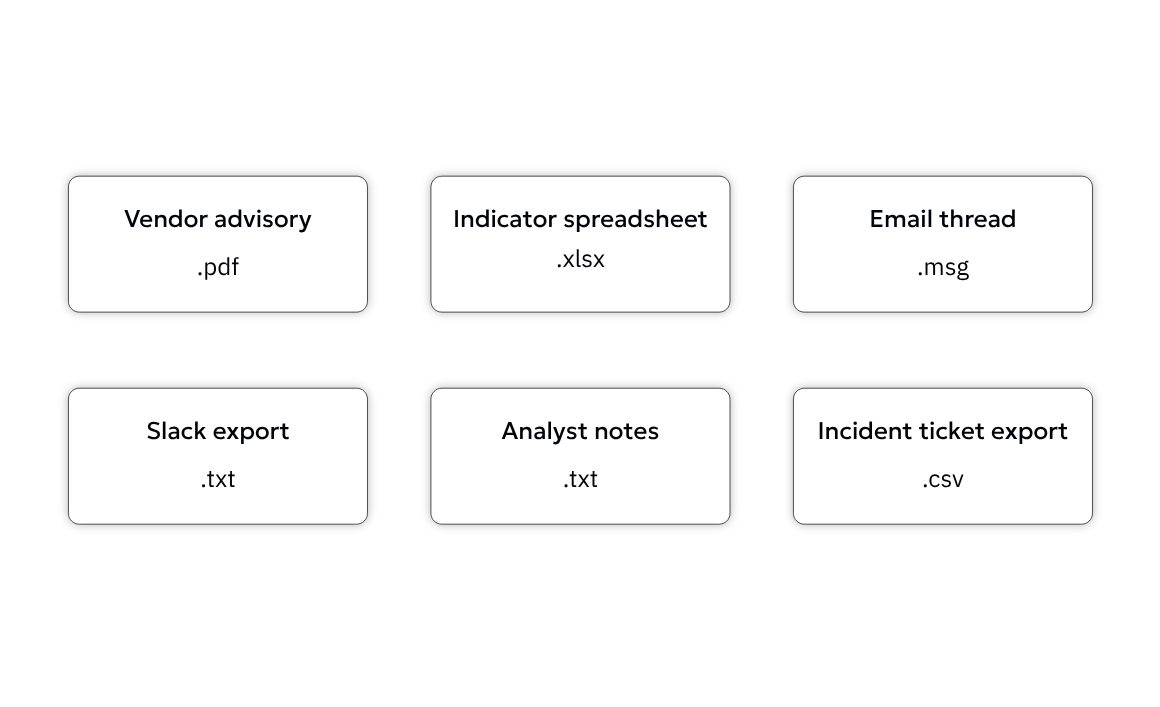
Rise blocks are the default. Storyline appears only where branching, simulation, or a change of state improves the learning. In Module 1, the learner inherits six handover files and finds there is no right one to open, because nothing connects.
Real screenshots, checked by hand
Product visuals are cropped screenshots, never redrawn approximations. I verified navigation, field names, and terminology in a live instance.
Assessment that means something
A 14-question knowledge check gates Module 4 in the Academy, with unlimited retakes. The capstone holds its feedback until the attempt is finished, because the certificate is a claim about competence.
Experts review the real thing
Experts won't read a long document any more than learners will. I sent them modules as close to finished as possible, one or two at a time, and kept my questions few and pointed.
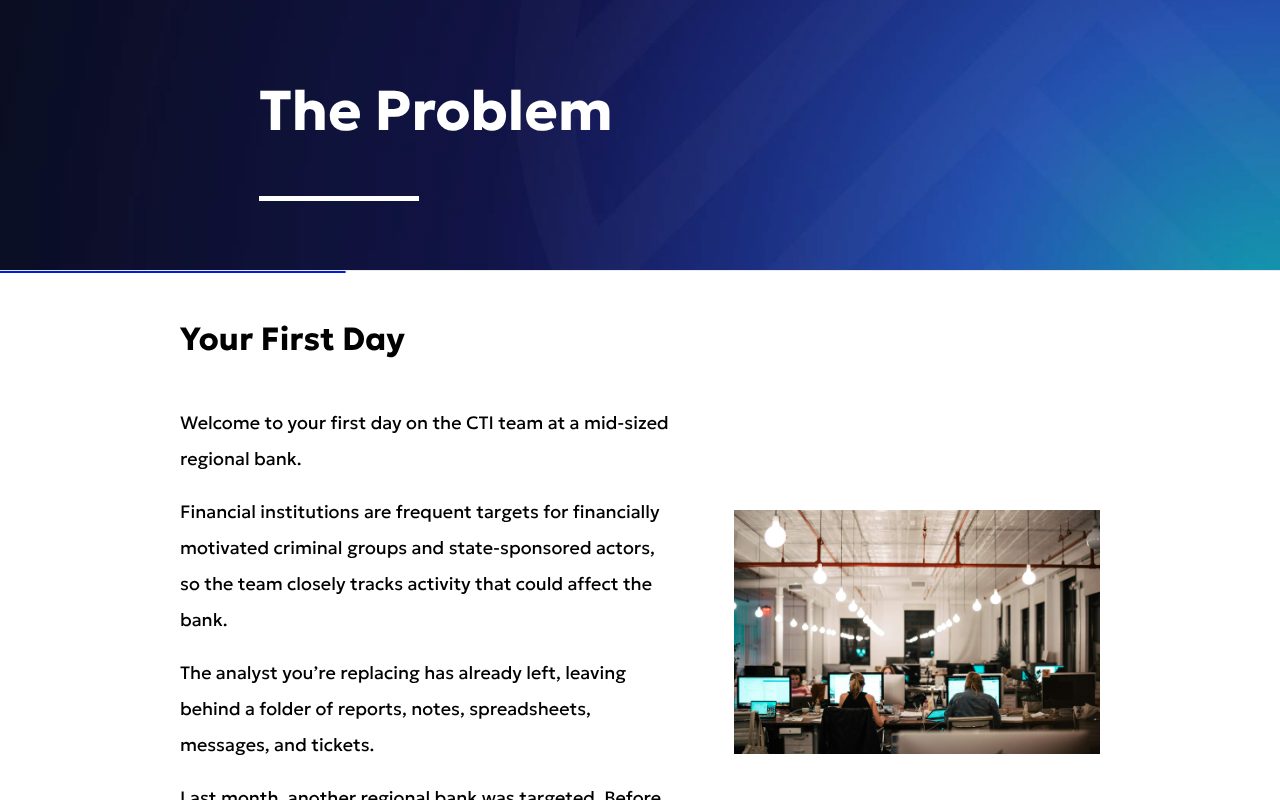
Opening screen of Module 1, titled The Problem, introducing the learner's first day on a bank's threat intelligence team
Module 1 opens on the learner's first day.
An activity showing six files left by a predecessor: a vendor advisory, an indicator spreadsheet, an email thread, a Slack export, analyst notes, and an incident ticket export
The handover folder: six files, and nothing connects them.
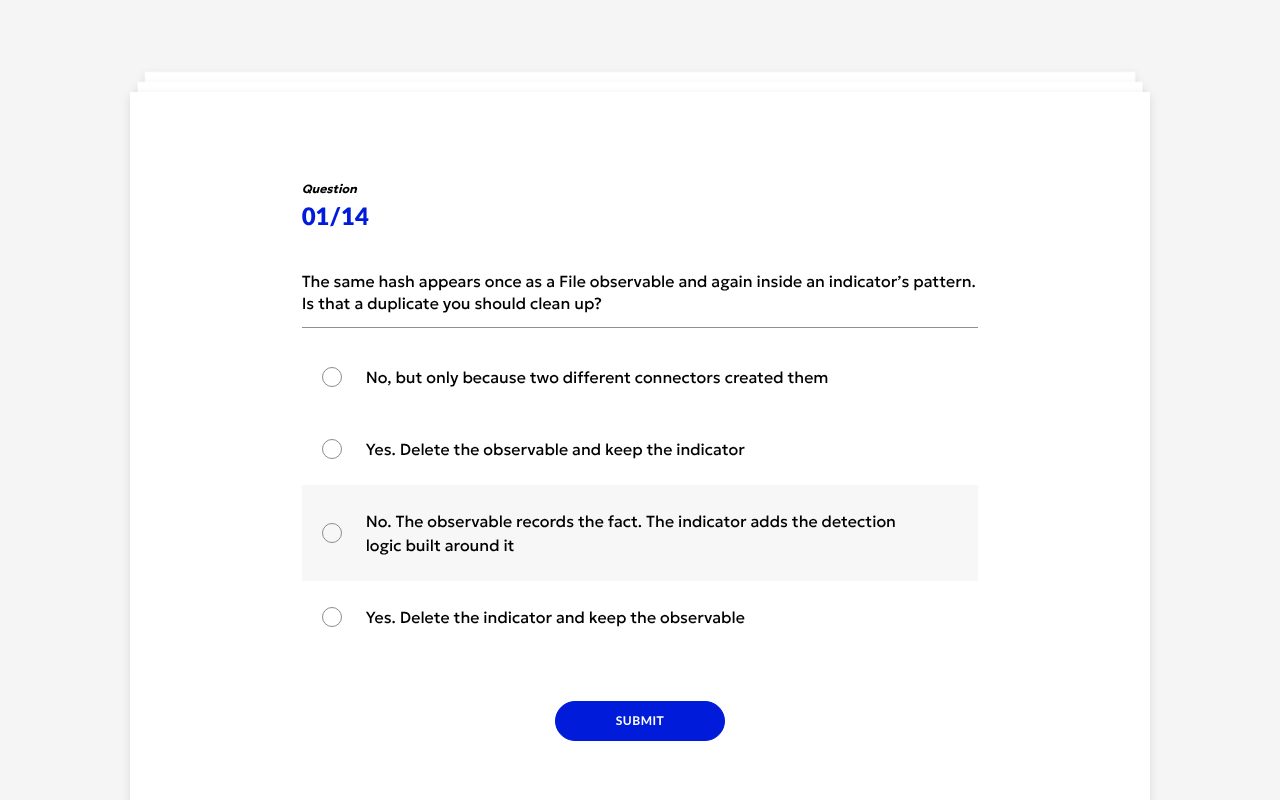
Question 1 of 14 in the knowledge check, asking whether a hash that appears as both an observable and an indicator is a duplicate
The Handover Review asks for judgment, not recall.

Running the Academy: operations and curriculum

Three full courses and six mini-courses shipped in 14 months, on production systems I built along the way.

Good courses don't ship on time by accident. Since joining Filigran, I've led content operations and production for the Academy and built the workflows the team now works from: how a course gets planned, made, reviewed, published, and measured.

My role
Lead for content operations and production
Scope
Curriculum roadmaps, production workflows, quality assurance, expert review, LMS publishing, reporting
Tools
Jira, Review 360, WorkRamp, LearnWorlds

What I put in place

Roadmaps and templates
Curriculum roadmaps that say what gets built and when, plus templates for quality checks and for briefing Marketing on a launch.
A visual component library
I built a library of reusable visual components and set multimedia production standards, to give the Academy's courses a shared look.
Recording with experts, wherever they are
A distributed recording program for subject matter experts spread across countries and time zones. The video below came out of it.
Reporting leadership can read
Academy performance reporting and executive dashboards that track registrations, enrollments, completions, and credentials earned.

Video with a subject matter expert

The opening two minutes of an OpenAEV 101 lesson on installing the product with Docker. I produced it end to end: I wrote the script, worked with the presenter (one of Filigran's support engineers) and set him up to record remotely, captured the screencast, edited the footage, and corrected the color and sound. The full lesson runs about ten minutes. With sound.

The course development workflow

I wrote this workflow and aligned the team on it. Every full-length course moves through seven stages, and each stage ends at a checkpoint that has to be true before the next one starts.

  1. InitiateOpen the project and draft the course outline.Checkpoint Outline approved and a subject matter expert assigned.
  2. PlanSet milestones and the timeline. Create the launch information page for Marketing.Checkpoint Timeline agreed and Marketing briefed.
  3. DesignTurn the outline into an instructional approach: activities, assessments, and supporting materials.Checkpoint Design ready to build.
  4. Develop and reviewBuild the course. Experts review for two weeks, then another content manager reviews for two to three business days.Checkpoint Content reviewed and ready for the LMS.
  5. Prepare and testConfigure the course in the LMS. Test enrollment, navigation, scoring, prerequisites, and completion tracking. Technical trainers do a final review on a restricted link.Checkpoint Final review done and issues fixed.
  6. LaunchMake the course public and update Marketing's launch page with final details.Checkpoint Course publicly available.
  7. MaintainReview learner feedback and course performance on a regular cadence. Update without disrupting learners in progress.Checkpoint Assigned maintenance complete.

Three principles hold it together. Each course has one owner who makes the day-to-day calls. Progress, blockers, and decisions live in one tracker. Marketing hears about a course as soon as its outline is approved, not after it's built.

The learning path: Crawl, Walk, Run

I defined what separates a 101, a 201, and a 301 course, so the team could decide where any topic belongs. All three levels teach skills, meaning what a learner can do. What changes is the complexity of the work, the independence expected, and the scope of responsibility.

Dimension101: Crawl201: Walk301: Run
Relationship to the productUnderstand itUse itOwn and optimize it
Core questionWhat is this, how does it work, and when should I use it?How do I correctly accomplish my work in the product?How should the product be configured, governed, and maintained for our organization?
What learners doRecognize, distinguish, interpret, classify, selectCreate, connect, investigate, update, collaborate, produceDesign, configure, govern, automate, troubleshoot, optimize
Organizational rulesUnderstand themApply themDefine and maintain them
Success standardMakes correct decisions about the productPerforms practitioner work competently and independentlyEnables reliable, secure, effective use across the organization

The boundary test I use to control scope: if the learner is applying established rules to get work done, the topic belongs in 201. If the learner is deciding or maintaining the rules other people work within, it belongs in 301. Using the platform is not the same as owning it.

Progression is defined by job performance and scope of responsibility. It isn't defined by seniority, job title, or how many features a learner has seen. Role-specific branches sit on top of the core levels, so not every learner needs every course.

Filigran Academy mini-courses

Six short lessons with one rule: each answers a single question, and each is quick to get through.

My role
Topic selection, scripting, design, and production
Audience
Filigran customers and users in the middle of their work
Format
Video, then animation, now short interactive lessons

The six questions

  • How to successfully fill out a customer success ticket
  • What a Decay Factor means in OpenCTI
  • What to focus on in OpenCTI after initial setup
  • Why your JSON feed mapper is not creating entities or relationships
  • Ingest threat reports into OpenCTI with XTM One and Stix Harvester
  • Map FIMI behaviors to Disarm techniques in OpenCTI

How the format changed

  1. Narrated slidesThe first three were recorded slide lectures. Feedback said the format felt dated, so I changed it.
  2. AnimationThe next three were animated.
  3. Interactive lessonsThe series is moving to short interactive lessons built in Rise: one lesson each, with a small cap on interactive blocks so they stay quick.

Watch one

The animated version of "Why your JSON feed mapper is not creating entities or relationships." 3 minutes 49 seconds, with sound.

How Search Works

Scripts for the first five episodes of Google's How Search Works series, which explains how Search crawls, indexes, and serves the web. Together they have been watched more than 630,000 times.

The hard part was organization. Search is a deep technical subject, and the audience ranged from SEO professionals to anyone with a website. I planned the five scripts as one sequence, so each episode builds on the one before it, and used analogies and everyday examples to make abstract steps concrete without bending the facts.

My role
Scriptwriter
Audience
Website owners and SEO professionals
Format
Five videos on the Google Search Central YouTube channel, each under five minutes

How the scripts were made

  1. Brief and researchI reviewed the client brief and the technical material, then interviewed the subject matter expert.
  2. Objectives firstI outlined all five videos with learning objectives for each before writing a line of script.
  3. ScriptsI broke crawling, indexing, and serving into segments a newcomer could follow, with an introduction and outro for each episode.
  4. Revision and handoffI revised with the video producer and the expert, then handed the scripts to design for storyboarding.

The five episodes

  • Introducing How Search Works209K views
  • How Google Search crawls pages145K views
  • How Google Search indexes pages92K views
  • How Google Search serves pages70K views
  • Anatomy of a Search Result117K views

View counts as of November 2026. Google has added more episodes to the series since these five.

More learning work for Google

Nearly five years across Google's developer education and developer marketing teams, as a technical writer and then a content strategist.

Build your first on-device ML app
I edited and developed content for this developer learning pathway, working directly with AI educator Laurence Moroney. The VP of Google Developer Studio recognized the work with a bonus.
developers.google.com/learn
As the only writer on a four-person design team, I worked on the redesign of Google's learning hub for developers. Session duration rose 20%. A blog post I wrote for the site earned 96% more views than its average post.
Google I/O Code of Conduct video
I wrote the script for the video shown before live sessions at Google's annual developer conference. About one million people saw it.

How I design

Harder on purpose
Most elearning is too easy to fake your way through. I cut the hand-holding so learners have to pay attention.
Wrong first
I write many questions so that learners miss them the first time. A miss followed by good feedback teaches more than a right answer picked by recognition.
Interactivity earns its place
Decisions, consequences, uncovering information, and feedback that means something. No points, badges, or countdowns.
The product is the reference
Real screenshots, checked against the live product. If I can't verify a claim myself, I ask one precise question of someone who can.

About

I'm based in Austin, Texas, and work remotely. I'm Senior Content Manager for Content Operations at Filigran, where I lead content operations and production for the Filigran Academy.

Before Filigran, I spent nearly five years on Google's developer education and developer marketing teams, designed training for Meta Blueprint, and wrote technical content for Confluent and Accruent.

I have a BA in art history from Purchase College and spent a year in film school at Brooklyn College. I worked on film sets, including as second assistant director on the feature Children of God (2010), and later wrote about art and books for Pittsburgh City Paper: reviews of the Museum of Broken Relationships and Firelei Báez at The Warhol, and a conversation with H is for Hawk author Helen Macdonald. That background still shapes how I build a course: I look closely, and I think in scenes. Who is in it, what they want, and what stands in the way.

I use AI tools every day in production, and I check what they give me against the live product before a learner sees it.

Authoring and delivery
Articulate Storyline, Rise, Review 360, SCORM, WorkRamp, LearnWorlds, WalkMe
Video and design
Camtasia, Adobe Premiere Pro, Figma, Snagit
AI
Claude, ChatGPT, Copilot Studio, ElevenLabs
Operations
Jira, Confluence, GA4, LMS reporting

Contact

If your product is hard to learn and your customers need to be good at it, I'd like to hear about it.

Message me on LinkedIn